A residential breaker panel is the central gatekeeper for all branch wiring across a building. In Los Angeles, thousands of single-family structures in neighborhoods such as Highland Park, Boyle Heights, and Los Feliz…
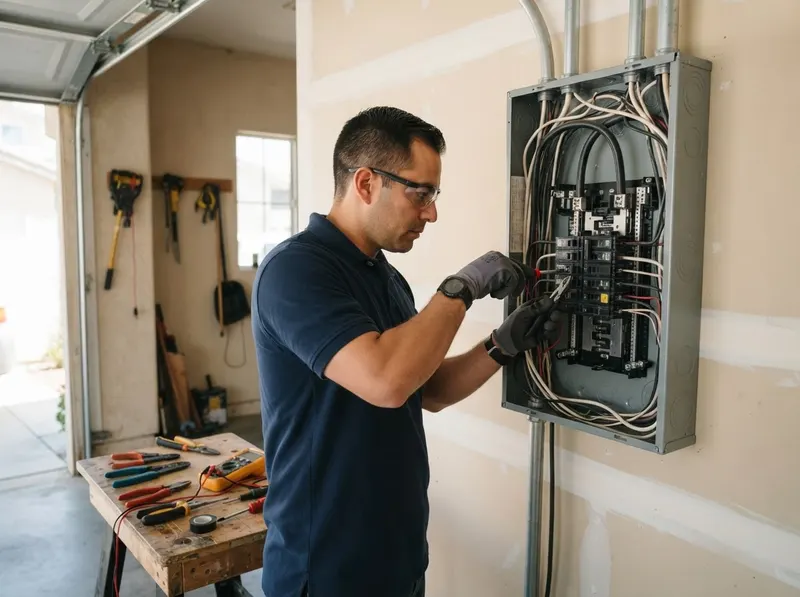
A residential breaker panel is the central gatekeeper for all branch wiring across a building. In Los Angeles, thousands of single-family structures in neighborhoods such as Highland Park, Boyle Heights, and Los Feliz still rely on 60-amp or 100-amp services installed several decades ago. These legacy configurations were designed before modern inductive loads, central heat pumps, electric vehicle chargers, and kitchen induction ranges entered widespread use. Overloaded circuits generate persistent breaker trips, localized heat build-up inside the busbars, and ungrounded outlet risks. Property owners operating with Zinsco or Federal Pacific Electric panels face additional mechanical failures, as those specific breakers often refuse to trip under a direct thermal overload, creating verified interior fire hazards.
Choosing between an internal panel swap and a total heavy-up depends directly on existing service drop capacities and household amperage demand. A straight 100-amp to 200-amp upgrade allows the installation of 30 to 42 individual circuit spaces, providing dedicated lines for solar battery storage or ductless mini-split systems common in Mid-City and Silver Lake renovations. If total calculated continuous demand exceeds 200 amps, frequent in multi-story residences in Brentwood or Sherman Oaks, a 400-amp split service or dual 200-amp panel setup is required. The primary trade-off is infrastructure disruption: keeping an existing panel footprint minimizes stucco patching, whereas moving the main meter socket to satisfy current LADWP clearance guidelines (such as maintaining a 3-foot by 3-foot clear working workspace clear of gas meters and property lines) introduces additional conduit routing and grounding electrode conductor upgrades.
Every panel replacement within Los Angeles County necessitates dual-agency synchronization. Work begins with an intake review to verify service conduit status, followed by filing for an LADBS electrical permit. On installation day, power is isolated at the service drop, the obsolete box is unseated, and new main breakers, arc-fault circuit interrupters (AFCI), ground-fault interrupters (GFCI), and continuous grounding rods are driven into the earth. Once work finishes, a municipal inspector must clear the physical installation before LADWP unlocks, reconnects, and meters the feed at full operating capacity. Local dispatch units navigate distinct architectural configurations from 1920s Spanish bungalows in Leimert Park to canal-adjacent residences in Venice, ensuring that all conduit bends and weatherheads comply with regional wind and seismic stability requirements.
Every job gets a firm, written price after a free on-site visit.
Tell us about your electrical panel upgrades & replacements job in los angeles and we'll send a clear, written quote, usually the same day.
 Bright Electrician